
Command & Conquer: Tiberium is a weird one. It was released at the same time as the third Command & Conquer game that goes under the same name. It’s a retelling of the GDI campaign, but in book format. However, the approach it takes is perhaps not what you’d expect. It goes into great detail explaining the life and politics of the average GDI citizen, with a small excursion into the minds of a few NOD members. Don’t worry, there are segments of battles too, but in general, the war is taking a backseat to world-building and the development of the main characters.
Slow beginnings
Just like the game, the main event that starts the conflict is the destruction of the GDI orbital space station GDSS Philadelphia. Before we get to that, though, the book starts by presenting the conflict in a much slower buildup, by explaining the intricacies of GDI politics and the current state of the world. It works, and is pretty interesting, since it’s things we know little about. Yet, there is a small problem. This segment feels more like a prologue, but it isn’t presented as such. All the characters involved in this part are eliminated when the space station goes up in flames. So, all that buildup, and the characters we get to know through these first pages will never make a return in the book. It’s just there to set up the conflict.
Now, it’s not bad, but I can’t help feeling it’s a waste. Because afterward, the two real protagonists are presented, with one being a reporter. Seeing as the fake (now dead) main character who got vaporized in space shares this profession, potential character development was squandered for an odd lenghty prologue, that’s only focus was on the background lore. I’m probably just nitpicking here, but I just thought the story would have a better connected narrative if these two characters were one and the same—somehow surviving the explosion. But it is what it is.
The two heroes
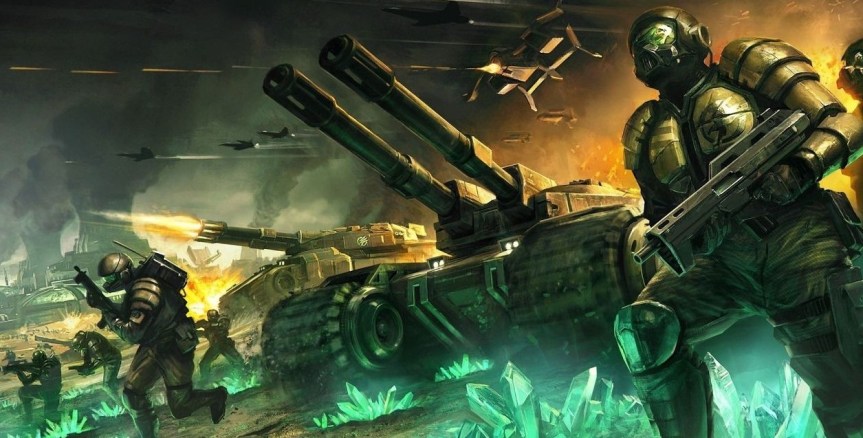
From this point we get to follow the real leads; Ricardo Vega, a fresh recruit for the GDI infantry, and Annabella Wu, a rookie reporter for W3N. The novel takes us from the start of the war, to the absolute ending, involving the mysterious third faction that I will not spoil for you who have not played the game.
What’s good about the book is the characterizations of the characters, and their struggles in their respective fields (military and civilian). You get a lot of cool information about how it is to live under GDI, with Tiberium (the green death) being an unrelenting threat to all life. Living in a blue zone is not all happy sunshine, as one might expect from all the propaganda and setup from the games. There is no Tiberium poisoning, sure, but the people here live under constant watch, with rules that best resemble a dystopian totalitarian society. A police state, in other words, with harsh rules, and harsher punishment for breaking those rules.
A yellow zone is much freer, but you must contend with weekly, if not daily ION storms, the danger of Tiberium and NOD recruiters wanting you to join their little suicide cult. None of these places feel like a pleasant place to live in, but this is what Tiberium has created for humanity. It’s a fascinating depiction of how life is under the devastation of the green plague. What is also interesting is how alien the people feel towards each other, while still being on the same side. Life is just too different between a yellow and a blue citizen, that they essentially don’t have any common ground. This works in favor for NOD recruiters, as it’s something they manipulate to create dissent for GDI. It’s a palpable take that makes sense looking at the franchise as a whole.
The war
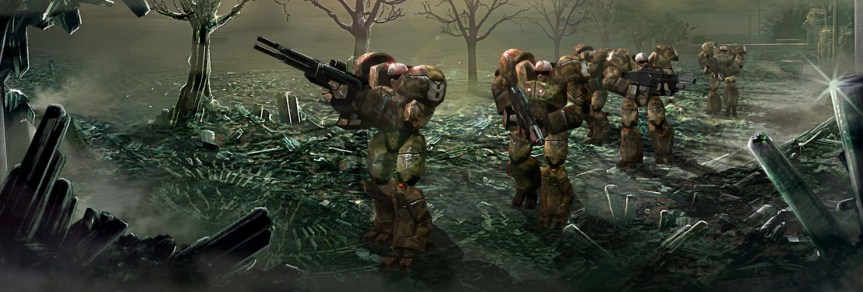
The central thing about Command & Conquer has always been the bloody conflict between GDI and NOD, regardless of how you bend it. It’s here where I find the novel stumbles a bit. While all the background lore, and the characters are well-written, I found the actual battle sections between GDI, NOD, and the other mysterious third force extremely lacking. It’s unfortunately mostly smoothed over as quickly as possible. Especially in the end, when the author seems to have lost interest in the setting, or just felt like he had to wrap it up. The combat scenarios felt small, and were over incredibly fast, and while the conflict is being presented as a global war, it comes off as tiny skirmishes that suddenly ended in victory for the GDI.
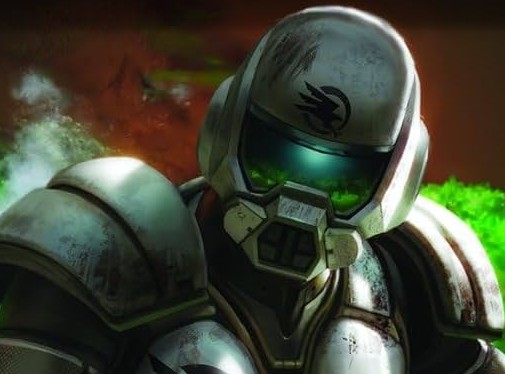
It’s a shame, as we have no in-depth strategy or tactics, or very little fun stuff that ties into the games, for example Tiberium harvesting. This crucial point of the franchise isn’t even mentioned! The book would have been much better if some balance had been achieved, but it seems like the author wanted something else for this novel. Once again, it’s not terrible, yet, it appears odd, seeing as war is the backbone of the series. If you are hoping for mammoth tanks rolling over wounded NOD soldiers praying to Kane in their final moments for survival, you are sadly out of luck!
Conclusion
Despite my feeling that the novel misses one fundamental part of the franchise: satisfying warfare that plays into the game. It’s still a curious read, as you get a deep look into the life of the average citizen. It’s engaging, and you don’t get that while playing the games, except for a few rare readable lore segments. If that makes you intrigued, it’s an easy recommendation from me. However, if you are after destructive war and lengthy gruesome battle scenes filled with tactics that tie into the games, Command & Conquer: Tiberium will probably frustrate more than please. Not terrible, not great, but still probably worth a read if you are a fan!
Thanks for reading.
– Thomas
 Tom's Gaming Vault